First layer
Local companions
AI beside citizens and facilitators inside each circle: translation, live captions, explanation, evidence on request. A scaffold, never a participant. Democratic authority stays with the people around the fire.
Powerful AI and the future of collective self-government
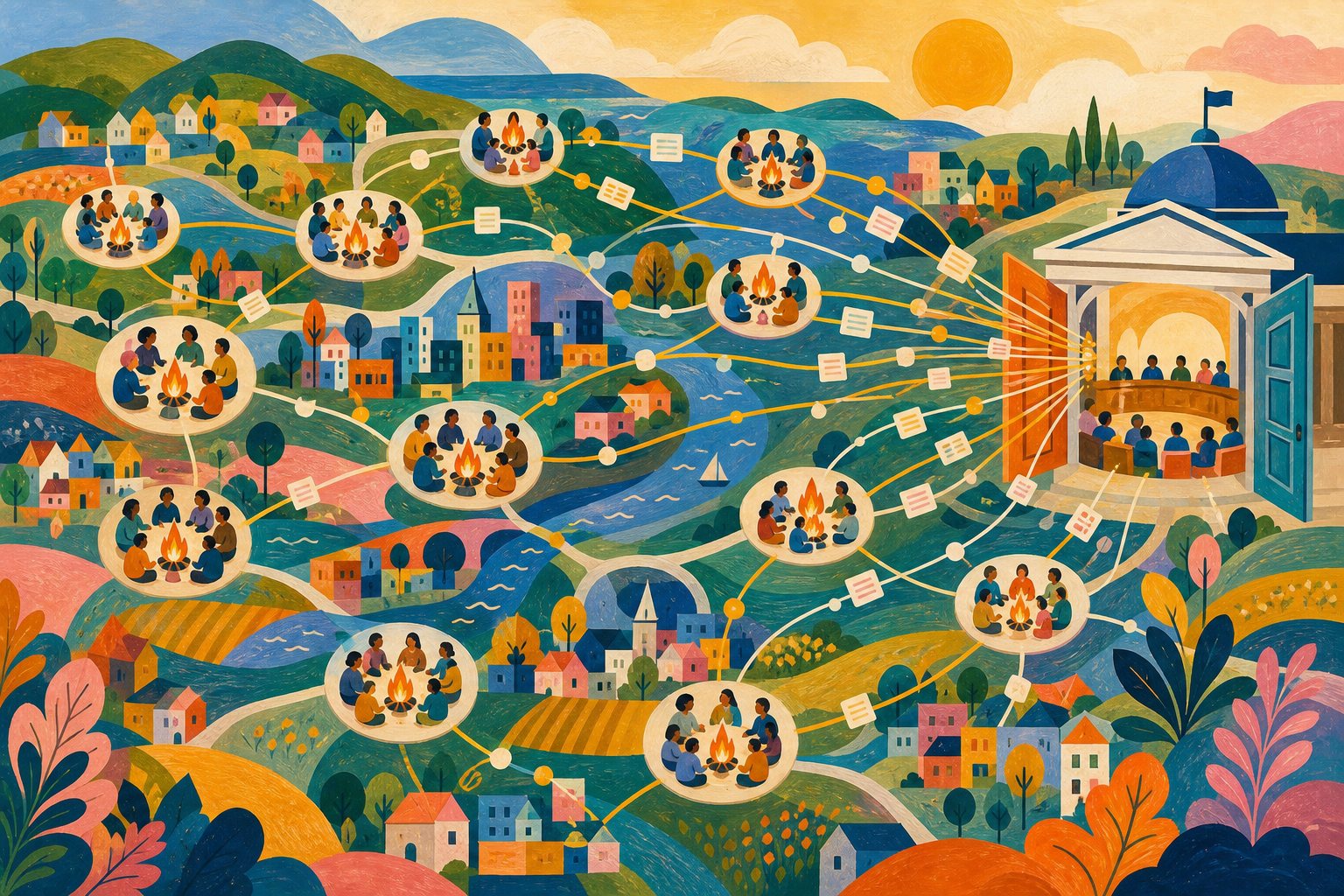
A democracy made of many small circles. Ordinary citizens reason together about the decisions that shape their lives, supported by AI as public civic infrastructure, and heard by institutions that have to respond.

The democratic promise of powerful AI lies in its potential to help people decide together more often, more deliberatively and inclusively, and with greater collective intelligence. From the paper
Eight days into his presidency, in the middle of a banking crisis, Franklin D. Roosevelt spoke to millions of Americans over the radio in plain, calm language, and helped restore trust in the banks. A new technology had been given a democratic form. But the conversation moved in one direction: Roosevelt spoke, citizens listened.
In Germany, the Nazi regime recognised radio's political power, created a propaganda ministry, and promoted cheap receivers to bring its messages into ordinary homes. The same technology that calmed a democratic public could mobilise hatred, obedience, and mass manipulation.
Each new medium opened democratic possibilities, and each created new ways to concentrate power and distort public life. Social media promised everyone a voice, then rewarded outrage, speed, and visibility over listening, understanding, and judgement.
ChatGPT made AI conversational and available as an everyday interface. Since then, frontier systems have become agents working inside the everyday machinery of learning, government, and coordination. The paper calls them powerful AI: they are already powerful enough to matter for democracy, whatever one believes about AGI.
Powerful AI can fabricate evidence, impersonate people, automate persuasion, and concentrate infrastructural power, while democratic institutions move slowly, partly because they should. Defending democracy from AI is necessary, but it is not enough.
This paper asks the complementary question: what democratic future could powerful AI help make possible? Not a louder broadcast, but a return to the circle, at a scale no earlier medium could support. Hopeful, and deliberately so. AI will not become democratic by itself.

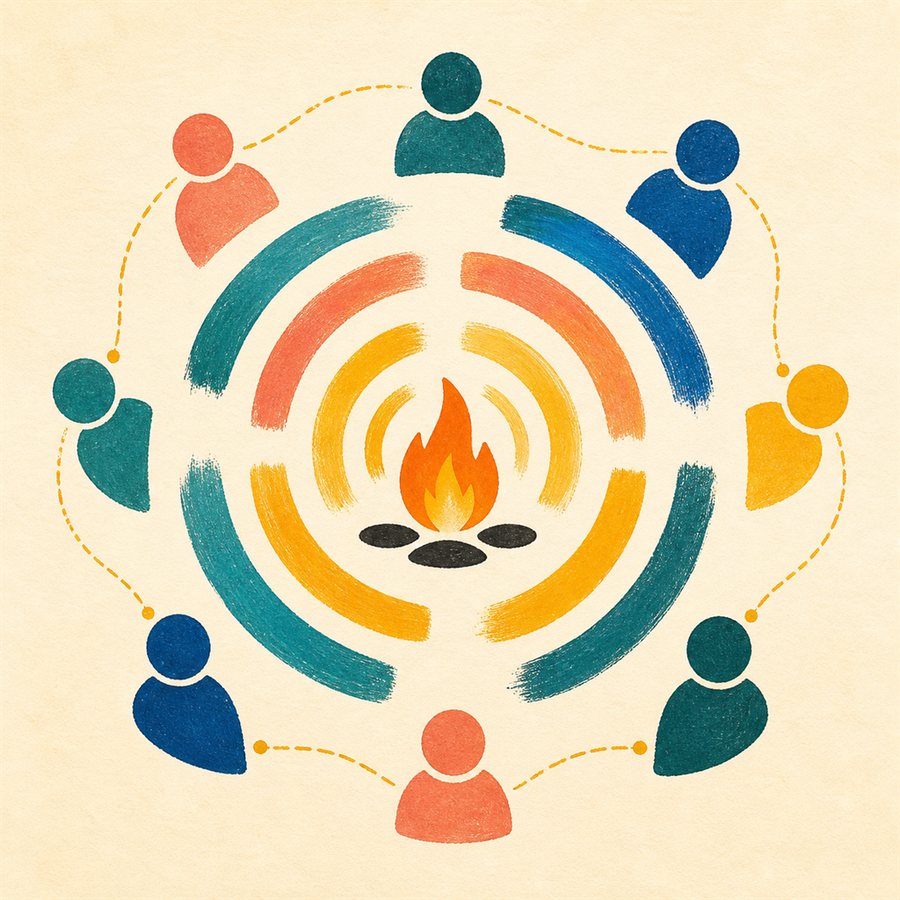
Around a fireside, people sit in a circle. They can see one another. They meet at eye level. They listen to stories and reasons. The fire gives light and warmth, but only when it is contained. Left uncontrolled, it burns. Each part of the fireside raises a question you can ask of any democratic process.

Who is outside it?
Human-scale settings where citizens sit at eye level and work through a decision together.
Can people understand the issue?
Evidence, trade-offs, and one another's reasons, made visible through explanation and translation.
Can those least used to speaking speak?
Invitation, accessibility, facilitation, turn-taking, and respectful listening.
Do reasons survive the meeting?
Records that carry the reasons, disagreements, and lived experience beyond the room, not just the recommendations.
Is public communication protected from wildfire?
Rules, oversight, and safeguards against manipulation, surveillance, and synthetic consensus.
Do institutions have to answer?
Public authorities listen, respond, explain, and sometimes change course. Without this, a fireside is only a warm room.
Citizens excluded, unheard, uninformed, unsupported, unable to influence decisions.
Citizens disagree, reason, listen, and decide under fair, public, consequential conditions.
Communication turns fast, hot, manipulative, polarising, and hard to contain.
Kate Raworth's doughnut gave economics a picture of a safe and just space. This is the democratic equivalent: a circle around a contained fire, between cold exclusion and uncontrolled heat. The safe space is where conflict can be heard, reasoned through, and connected to decisions.
Good deliberation needs small groups, and small groups need a way for their reasoning to travel. The paper proposes powerful AI as civic infrastructure in three layers, judged also by what sits beneath the fire and by what the fire consumes.
First layer
AI beside citizens and facilitators inside each circle: translation, live captions, explanation, evidence on request. A scaffold, never a participant. Democratic authority stays with the people around the fire.
Second layer
Systems that preserve and connect public reasoning across time and place: source-linked transcripts, reason maps, dissent registers, implementation trackers. AI output remains draft memory until people have reviewed it.
Third layer
Independent, publicly governed systems that make visible what no single room can see: coordinated manipulation, synthetic participation, repeated exclusion, and institutions that quietly ignore citizens.
Chips, data centres, models, data, energy, labour, and ownership. A fireside is also judged by who controls, pays for, and can inspect what it is built on.
What the fire consumes. The smallest system that can do the democratic job, with energy and water use measured, capped, reported, and reduced over time.
The boundary is democratic, not cognitive. AI can generate impressive arguments, but it has no stakes, no vulnerability, and no standing as a citizen. From this follow responsibilities that stay human, and lines that are not crossed.
“A synthetic public is still not a public.” From the paper
Democracy needs connected firesides rather than isolated flames.
From the paper
Seven overlapping steps, measured by one test: do citizens become more able to deliberate and decide together? Stronger memory, clearer accountability, deeper inclusion, lower ecological cost, greater public power.
Every new communication technology, from radio to social media, has opened democratic possibilities while creating new ways to manipulate the public.
Powerful AI is the next chapter, and the stakes are higher because it is general-purpose and increasingly able to act inside the systems societies use to learn, govern, and coordinate. Alongside the necessary defensive debate, this paper asks a hopeful question: what democratic future could powerful AI help make possible? Its answer is Fireside Democracy, a democracy of many small, connected circles where ordinary citizens deliberate on decisions that shape their lives, and where institutions must respond.
The paper surveys today's deliberative AI tools, proposes a three-layer architecture of local companions, democratic memory, and publicly governed integrity systems, and sets out design principles, red lines, governance institutions, ecological limits, and a practical roadmap. Its core rule: AI should support deliberation, never substitute for the citizens whose judgement gives it democratic meaning. Better tools are not enough on their own: they need public deliberative infrastructure for many connected firesides, built around human authorship, democratic control, ecological limits, and institutions that turn citizen reasoning into public consequence.
Democracy's deeper promise: people affected by decisions should have meaningful opportunities to shape them through public reasoning among equals. Citizens' assemblies and juries show that ordinary people can do this well when the conditions are right. Such deliberation remains rare, episodic, and weakly connected to real power.
The bottleneck is missing infrastructure: fair selection, accessibility, balanced learning materials, skilled facilitation, documentation, and routes into real decisions. Six recurring infrastructure problems: access, light, warmth, memory, connection, and consequence.
A survey of existing tools across the life cycle of a deliberative process, before the room, inside it, between groups, and after. Genuine promise, and a danger line: AI supports deliberation when it helps people understand, speak, listen, remember, connect, and hold power to account. It crosses the line when it performs these acts in place of citizens.
The central proposal: local companions inside each circle, democratic memory between circles, and publicly governed integrity systems around them, judged also by the stack beneath the fire and by ecological boundaries.
Public judgement, recognition between people, care for the room, democratic practice, and public authorship. Synthetic publics and AI agents deliberating on behalf of citizens mark the clearest danger line.
Eight design principles, from visible scaffolding and provenance to honest refusal and ecological proportionality, and the hard red lines that follow from them.
Deliberative AI should not be owned, designed, funded, and audited only by those who profit from deploying it. Public-interest institutions, steward ownership, public procurement, and governance of the whole stack.
Near-term, deliberative AI complements representative institutions. Over time, recurring citizen deliberation could shift where democratic authority lives: elections as one institution among others in a broader system of collective self-government.
Seven overlapping steps from scattered tools to a public hearth, from open evaluation and shared standards to governable stacks, ecological discipline, and consequential deliberation.
Back to Roosevelt: the public was reassured, addressed, and informed, but never convened. The next fireside will not become democratic by itself. It will be shaped by design, ownership, funding, legal, and ecological choices.
Cite as: Salecker, L. (2026). Fireside Democracy: Powerful AI and the Future of Collective Self-Government. fireside-democracy.com
The paper is the spine. Around it, this site will collect ways to encounter the idea: a podcast conversation generated from the paper, talks and slide decks, and the full text itself.
In production
A generated conversation about the paper, episode by episode: the story, the idea, the architecture, and the roadmap.
Get notifiedComing soon
Talks and slide decks on Fireside Democracy, for conferences, public institutions, and practitioners of citizen participation.
Invite a talkPublished 2024
The 2024 essay with The Next Era where Fireside Democracy began, free to read now.
Read the essayLukas Salecker works on AI for citizen deliberation. With deliberAIde, he supports public institutions in running and analysing deliberation processes: real rooms, real transcripts, real decisions. Fireside Democracy grew out of that work, beginning with an essay published with The Next Era in 2024 and now becoming a full paper.
The argument has been sharpened by feedback from more than twenty researchers and practitioners of deliberative democracy. The mistakes that remain are the author's.